Showing posts with label IIASA. Show all posts

Thursday, December 6, 2012

SA-YSSP

This weekend I was invited to address the first group of SA-YSSP participants at the University of the Free State (UFS)  at the opening ceremony. As a past participant of the YSSP program at IIASA, I was asked to talk to the students on what they should hope to take away from  the experience.

I won't repeat it, but I hope the students embrace the opportunity they have been given and share their cultures, research and life journeys. I hope they soak up everything they are shown and taught, it really is a unique experience.

Following the opening ceremony, I was privileged to talk to the individual participants and hear their plans for the Summer.

The following  two days I got to join the Bloemfontein tour,  lunch and Campus tour.

The UFS Campus is rather spread out, with a wonderful postgraduate library designed to serve their interests! Reminded me of IIASA's library and librarians.

The Bloemfontein tour took us part buildings of interest, the Wildlife Reserve and my mom's old school :)

Zanchieta, the Wild Cat Farm outside of Bloemfontein served as our lunch stop. The cats are rescued, boarded or owned the the family that own the farm. They are beautiful to behold. 


Monday, January 31, 2011

Visiting Research sites in Cape Town

I was fortunate enough to be invited to attend the joint conference between the NRF, SADC Science government officials and IIASA in Cape Town last week. As part of the conference various visiting officials were taken on tours of some of Cape Town's research centres. We had a glorious walk through Kirstenbosch Botanical Gardens where much of the countries biodiversity research is done, as a guide pointed out various species of interest. My favourite section of the gardens is still the Cycad garden and Bird Bath.

Rhodes Memorial and District Six featured as our historical element of the tours. For those unfamiliar with either the context or their meanings I suggest reading up on both. The District Museum is a veritable font of information and the map on the floor that ex-residents have personally filled in on their visits is rather enlightening. The guides are ex-residents and can tell many a story from the time.

Our site visits also included Koeberg Nuclear Power Station(including the inside!) complete with safety boot, earplugs and glasses. Let me just mention at this point that it is loud in there, I do not envy their resident engineers. One of the most interesting parts of the tour was the safety procedures in place and the emergency evacuation strategy in case of an accident.

Another facility that I have done a lot of work with in the past is the Centre of High Performance Computing (CHPC) in Rosebank. Open to research institutions throughout the country and potentially other SADC countries, the CHPC has a number of clusters for simulating various "Grand challenges". A few examples off the top of my head is protein folding, climate modelling, fluid dynamics for planes, ocean current modelling etc. These are applications I have seen presented at CHPC conferences over the years. I am sure there are many more.

Friday, August 20, 2010

A Day in the Life of a YSSPer

Ben wrote a Day in the Life in June when the days were quiet(ish) so I thought I'd write an update now that the our time is coming to an end (4 days til presentation day!) of what we do on the average day.

7.15am The Early Morning M-Bahn (or Tram/Bus combo on party days)

7.45am Arrival at the Schloss
We generally have to unlock the front door as official hours are 8.30am - 5.30pm. Its actually quite sad getting to the office this early in the morning.

Depending on the day, the Schlossplatz is humming with activity as some group set up stages, booths, stalls for whatever event to being hosted there next. On friday morning we have a few farmers market type stalls.
7.45am - 9am Browse webcomics and online newspapers

9am - 12pm Work on stuff, maybe read a paper, annoy your officemates by starting a discussion on a topic you need help with the other YSSP in the office

12pm Lunch
Lunch in the Schloss Restaurant is a rather social event most days. On sunny days we sit outside under the trees and solve the world's biggest problems over some deep-fried concoction ranging from 2.10 euros upwards. Depending on the day we get to puzzle over how the lunch menu fits together and what exactly they decided to deep-fry on the day. The other day was diced celeriac and cheese patties! The presence of a salad bar is much appreciated (except when its all coated in vinegar).
1.30pm Sleepy time after all that lunch...must work...

3.15pm Mid-afternoon snack (Eissalon anyone?)

3.30pm-5.15pm Work stuff frequently studded with mutterings in foreign languages as the model breaks...again

5.15pm Leave time (unless there is a party planned, see below)

5.30pm Party time
On certain evenings STAC/YSSP organises a party which fits into the "work hard, play harder" philosophy here. Its nice to be able to unwind, chat to staff or fellow students and escape the office.

8.50pm Waiting for the bus

As the sun sinks in the "early evening" we seek to catch the last rays of sunshine after being in the office during the day. The IIASA wireless works at the bus stop and provides an excellent opportunity to catch up on FB and emails.

9.20pm The Last Bus

9.25pm The Commute Home


9.45pm Quellenplatz
The commute home takes 45 minutes if everything is timed perfectly but can take up to an hour if the tram arrival does not coincide with the arrival of the bus at Quellenplatz.

10.20pm Simmering again
View from the 5th floor balcony (at 6pm not 10pm, the sun doesn't stay up that late!)

10.30pm Dinner / Evening snack (or Potluck)

10.40pm Check up on stuff at home

11.30pm Whoops!
Realise you're going to have to get up at 6.30am and should really go to sleep

Friday, August 13, 2010

Schloss Tour

We finally received an official tour of the Schloss this morning including the normally off-limits areas. I've written about the history of Schloss Laxenburg back in June but now I have previously unseen photos to show.

Our tour started with a building no longer connected to the Schloss, the Orangarie (Winter Garden) that housed the oranges and plants in the Winter months and provided fresh fruit to the castle when the royals were in residence.
As we walked back you have a nice view of one of the wings of IIASA with the Belvedere (tower). The next stop on our tour took us through the Conference Centre that used to belong to IIASA and was sold off in the 80s when IIASA had some financial difficulties. The conference area has a stunning entrance way and stands outside the old stables for housing carriages.

The conference centre has a series of rooms all painted or wallpapered in lavish splendour, perfect for a ball. Pity about the price tag though. With reductions the hire of the 2 rooms in the venue (no services or catering) is 3000 euros.


The conference centre also houses a small concert hall that has been altered a fair bit from the original design. The photo below shows the royal box which is now directly over the stage when previously it was in fact facing the stage.

All the buildings were in terrible disrepair about the world wars and Nazi and then Soviet occupation (there was a mini battle in Laxenburg Park) and the everything had to be restored from photos and notes. All the chandeliers, paintings and furniture are imports from museums or were stored somewhere else during the wars.

One area that is strictly out of bounds normally is the Directors Office and Breakfast Pavilion. While the director was out for lunch we snack in to see the famed picture of Maria Theresa in the Elisabeth Room. Snazzy office :)


The view of the park and conference centre from the pavilion is beautiful to behold. I'm told the people with offices in the Park Wing (APD) get to see weddings in this area on a regular occasion.


The last photo is taken from the top of the Belvedere and if you look closely enough you can see Vienna.

Asia Day


Asia Day was a gastronomic delight as food from every corner of Asia was prepared for us to feast on. As with Africa Day the food queues were really long as people asked questions about the food and how it is prepared etc. I saw a lot of heaped plates.

I can't even begin to name all the food prepared. I can however name some of the countries represented: Japan, China, Korea (mmm... bbq), Iran, Indonesia, Pakistan, India, Nepal.

As with any Asia party, the traditional costumes were beautifully colourful, sort of like birds of paradise. I really wish I had managed to organise a sari for the evening.

The Asia staff and students organised a series of cultural exhibitions which included a play written by one of the staff. Though plagued with a few sound issues, they performed beautifully and it made for some fun.


Cultural Program:
  • IIASA-YSSP Musical Group “Pro-Tempore“ : The Snow at the Feet of the Maharaja.

The staff and students have been practising in secret for weeks now to present a play. Various members of Forestry were talked into playing bodyguards for the beautiful queen. Our YSSP coordinator even sang for us :)


  • HSC: Flash Mob Dance


  • Elena Rovenskaya : Belly Dance
  • Suchi Subramanian : Bollywood Dance
  • Subramanian Family : Indian Melodies
  • Haiguang Hao : Tai Chi


  • Sarthak Gaurav : Indian Rhapsody

Thursday, August 5, 2010

Climate Change Negotiation Simulation

Today IIASA staged a Climate Change Negotiation Simulation as part of our YSSP. YSSP participants we assigned a country to represent one of: Brazil, Canada, China, Germany, Grenada, India, Japan, Russian Federation, Sweden, Sudan, UK, USA, Australia, Poland, Hungary etc etc. Basically a mixture og G8, G20 and G77 countries.

My initial reason for taking part was to experience a negotiation situation as I am always frustrated by the reports in the newspapers of failure following these negotiations. I can now understand why. We were each assigned a country, or given NGO status to observe the proceedings. I was assigned Australia, an environmental activist of sorts that was campaigning for tough emissions targets and to introduce the concept of "climate change refugees". My simulation tip notes featured some countries I should negotiate with and some that needed more persuasion. I was told to criticise African countries (which goes against my personal feelings) and push for developing countries to accept that they are not exempt from the guilt just because they are still growing economically.

M&M Negotiations

Before the official negotiations began we played a simple negotiaton game where each person is given five pieces of paper in different colours, you have to negotiate to get 5 pieces of the same colour. It was hilarious as some people walked around talking your way into a colour while others just sat and waited for people to come to them. Quite interesting to try.

Negotiation Simulation

Throughout the negotiation process we discovered other's country mandates, game instructions and a few hidden agendas. Ariel as game master observed the proceedings and pushed forward negotiations with ad-hoc instructions for countries to carry out. Examples of these were criticising the chair for bias, not following due process, changing stance mid negotiation, stage a walk out, start forming a coalition. It made the process quite baffling at times.

There are few keys thing I have learnt from the experience. When negotiating, there must be a clear language for all parties, such as what emissions means vs emissions intensities, what does respected mean etc. I also learnt that one needs negotiators with technical know-how to negotiate, not political figures that do not understand the implications of the various proposals tabled for discussion.

Monday, August 2, 2010

Philosophy for a United Earth

Professor Joseph Agassi of Tel Aviv University gave a talk on the Philosophy for a United Earth this morning. While I'm not sure if I would buy into the argument for a global institution I did appreciate his comments on if only... Think back to the last time you said If only, it is an escape clause, something one says when one expects failure. I hadn't really considered this before.

Friday, July 30, 2010

Bibliothek

I know I've written about this before but I love the library at IIASA with its self check-out system, long-term loans (minimum 2 weeks, maximum a few years) its a marvel of efficiency in comparison to home. Maybe it is the contents I appreciate, the service just makes it better. The library is almost entirely made up of systems analysis, statistics, policy, modeling and decision-making textbooks, all helpful to my research.

The library has two reading rooms which in today's world of electronic journals and online books may soon become a thing of the past. The lighting fixture in the room is worth taking a peek at.

If you zoom in on the photo (not compulsory I promise), you'll see a multitude of yellow slips sticking out from between books. These indicate a book has been borrowed and by who.

Korea's Science and Technology Policies

Yesterday IIASA hosted Prof Chan-Mo Park, the president of the National Research Foundation of Korea. Prof Park detailed the vision of Science and Technology in Korea under the new government. He emphasized Green Growth, the integration of Green Technology into all sectors and believed this is the future for a developing nation. As a result the government is rapidly increasing their S&T budget with a large percentage going to R&D. It is nice to see governments pushing the Green vision and a belief in Science as a way to empower a nation. The Korean government has set very ambitious targets for the next 5 years which may be impossible but the philosophy behind this shows a nation that is very serious and not just paying lip service to the Green vision. I look forward to seeing the results.

Prof Park also detailed some of the work on S&T co-operation between South Korea and North Korea. Earlier in the Summer we had talk on Diplomacy in Science and this is definitely a fine example diplomacy in action. One very interesting thing I learnt was about the strength of North Korea's software developers, with the right resources I believe they could seriously compete on the international stage.

Saturday, July 24, 2010

PPA: Decisions: Power and Rationality

Friday our ever decreasing group of public policy students debated the process of making decisions and what types of rationality exist. As the penultimate seminar we have almost completed the policy analysis cycle. Our reading list for the seminar included Lindblom and Dahl. Dahl argues that a key characteristic of a democracy is the continuing responsiveness of the government to the preferences of its citizens, considered as political equals. A political system which has the characteristic of being almost or completely responsive to all its citizens.

You can for the sake of argument and analysis divide most governments in four categories based on Contestation (C) and Inclusion (I). High C / High I, High C/ Low I, Low C/ High I, Low C/Low I. From this can further analyse with respect to:
  • How the power is distributed
  • Role of the state
  • Nature of conflict
  • Whose interests prevails
  • Basis of power


The other topic up for debate was Rationality. Now this interests me, I've been reading up on rationality in decision-making for modeling purposes. The two we explored were Incrementalism (Partisan Mutual Adjustment?) and Bounded Rationality.

I'm really interested in Bounded Rationality and how people cannot considered more than a certain amount of information, important when asking decision-makers to pick based on multiple criteria or systems with multiple implications.

If by this point you're wondering when I became a social science convert I can quite adamantly profess to this being my only foray into the world of qualitative, mumble-jumble in which there are few wrong answers...I'll even take statistics equations over this world.

Reading List:
  • Charles Lindblom (1950), “The Science of Muddling Through”, Public Administration Review, (19), Spring 1950, pp.79-88.
  • Robert Dahl (1971), Polyarchy: Participation and Opposition, Yale University Press, Yale., Chapter 1: “Democratisation and Public Opposition”

Thursday, July 22, 2010

Africa Day Announced

Africa Day preparations are well under way, the recipes decided, the music coming together and soon the vuvuzelas will arrive all the way from South Africa. Aapo made the coolest poster to promote the event, one that truly embraces the colour of Africa. I'll be sure to post the recipes after the event, its going to tour of our favourite African cuisine.

Wednesday, July 14, 2010

Media Training - Know Your Media

IIASA offers a voluntary 4 hour workshop of how to present oneself to the non-specialist community, in this case journalists. The motivation is derived from the theory that the media is a powerful influence and creating a positive media profile can help with funding. Another is that if you fail to communicate your work others may do it for you and get it WRONG. Science is uncertain and we need to communicate the uncertainty better.

Before going into an interview remember the following:
  • Know your interviewer
  • What is your target audience
  • What is your key message
  • Why are you being interviewed?!

I've discovered through this process that scientists should have a 30 second pitch, the classic "elevator pitch". If it is prepared then you do not have to promote oneself (as scientists are notoriously bad at it) but the research area and implications/value for the public.

Remember:
"You do not really understand something unless you can explain it to your grandmother" - Albert Einstein

As the sun sets on another day at IIASA we have officially completed half of the YSSP. Scary thought. Yikes.

Tuesday, July 6, 2010

IME: Coping with Uncertainty: Spatio-temporal heterogeneities

The second uncertainty seminar dealt with spatio-temporal problems. This seminar series is not meant to teach us new techniques but to create an awareness that one shouldn't automatically use the stock standard stochastic tools available like averaging, regression etc.

When analysing spatio-temporal problems they often have multiple scales, high dimensionality and multimodal dimensions. There are methods available to deal with this, most notably discounting and Fast Monte Carlo simulations. Consider the scatter plot above, its multimodal. How do you describe the multi-dimensional density function?
The Adaptive Monte Carlo STO procedure can be used for optimization module (structural and non-structural decision, production allocation).

All these techniques are all of interest to me currently. I'm currently designing a decision framework and to cope with the uncertainty one needs to implement some sort of robust solution. Note the some sort, I haven't got there yet.

Schloss Restaurant

I have previously mentioned the cafeteria that we eat in most days, originally built as a 'house' for the Princess of the Emporer who lived in Schloss Laxenburg (my office building). This building has the same architectural style of high ceilings, chandeliers and artwork galore. I thought I would share with you some snapshots from our not so humble 'food court'.

Warning: There Be Lions. Munich had them and I seem to be noticing them around Vienna and Laxenburg, lots of statues of lions. Its not only in Africa...


The photo on the right shows the Oval Room, the main dining area (there are many small rooms within the Schloss Restaurant).


This could be mistaken for a piece of art on the wall but is in fact part of the scene from the ceiling.

The next shows the meeting room complete with mirror topped table. Some of the YSSPers booked it for a lunch meeting. It felt very wrong to eat off plastic trays in such a fancy room. They even put fresh roses on the table for us that day.

Finally a photo at dusk over the back garden of the Schloss Restaurant. The yellow building positively glows as the rays of the sun disappear behind the clouds.

Friday, July 2, 2010

Stars and Stripes

We're really being given a chance to implement Buzz Hollings 'Work Hard, Play Harder' philosophy this week. After yesterday's pancake feast we were tantalised by the offerings of the American contingent: hamburgers, hotdogs, brownies, popcorn and apple pie.

Carl directed this occasion with an exuberant flare and earned the nickname Captain America, pictured here with our YSSP co-ordinator Sheila.

The program today included lots of food, games and a quiz on obscure American History (Ben, Sheila and I came second after a tie-breaker), take that all lecturers who said informative guessing doesn't work on exams :)

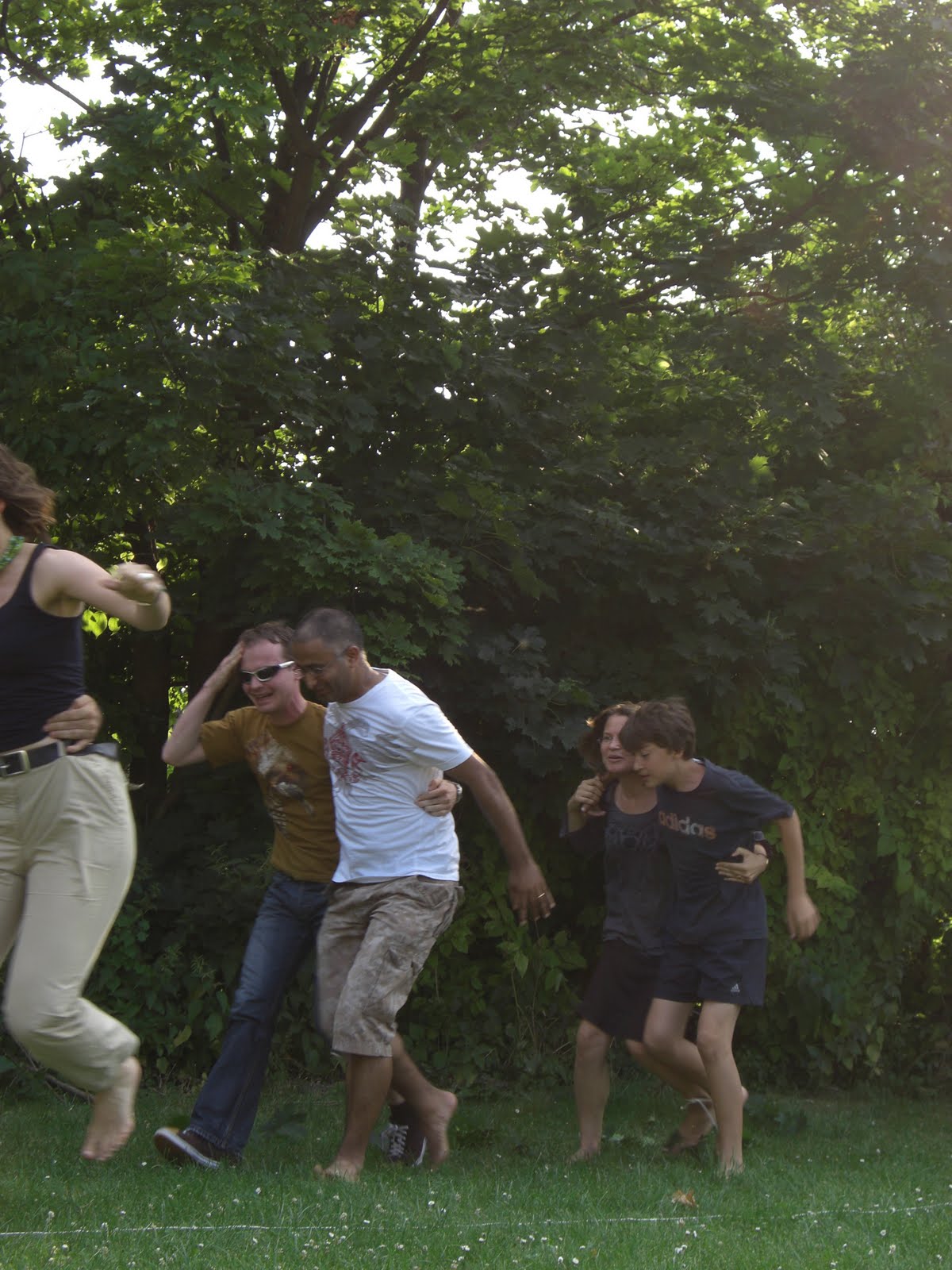
The games made for every interesting viewing: water toss, 3 legged race and dizzy bat. The first two probably don't need any explanation but dizzy bat is rather strange. Its a relay race where each team member has to run to a pole, out their forehead on the top of the pole and run around the pole 6 (or however many specified) times and then run back to your team. Many a person starts running after the circles and suddenly the ground comes up to meet them, very amusing to watch. I got to be a team judge (which meant no embarrassing moments).

IME: Modeling Primer

Yesterday afternoon saw the second seminar of the day, 'Modeling Primer' by the IME group. This lecture delved into the world of rational decision making: making the right decision at the right time. The right decision takes experience, intuition and knowledge (facts and rules).

It is a myth that it is easy to find a solution to a complex problem, for simple cases the decision is correct but you are taking a chance for complex problems.

A model is an adequate (for a purpose) representation of a part of (interdisciplinary) knowledge. I reiterate a quote from the beginning of June: All models are wrong but some are useful. They provide a tool to HELP find the best decision. BEST is merely a suggestion of decisions for reaching certain goals which can be done through analysis of trade-offs between conflicting goals or an evaluation of the consequences of various decisions.

A model requires consistency, transparency, replicability and documentation. Something to remember is that RARE events do happen, the low probability mean it won't happen.

Some parting words of wisdom from A. Einstein - "Everything should be made as simple as possible, but not one bit simpler." Words to live by.

Thursday, July 1, 2010

Science on Global Problem Area: Poverty & Equity

Today's seminar on Science on Global Problem Areas focuses on Poverty and Equity. This topic relates specifically to southern Africa and there are many questions and few answers. There are a few strategic research questions and themes presented by HGC, POP and ENE:

Understanding Poverty:
  • Systems analytical approaches to poverty (different dimensions of poverty and their linkages)
  • Implications of population and social dynamics on risk and vulnerabilities
  • Welfare benefits of improved access to basic good, services and technologies
Understanding Equity:
  • Analysing distributions;schemes for allocating scarce resources
  • Impact of drivers of global change on distributions, risks and vulnerabilities
  • Competing normative principles of fairness
Translating to Effective Policy:
  • Circumstances under which policies achieve development goals
  • Translating results from systems models
  • Fairness of setting policy
POP presented a research area that looks at correlation between education and health care as a means to alleviate poverty. This is an interesting question: Can Education help solve poverty?
Africa (and South East Asia) features heavily in the worst end of the scale for mortality across the indices. It is well known (or is it?) that as your education level increases generally your income increases and hence your health. There is literature to back this up that a higher education makes more of a difference than higher income (examples: India, Indonesia) however there are a few countries where this correlation does not hold (example: Cuba). Many WHO survey graphs from 2004 were presented as a motivation but bizarrely South Africa did not show up on a single graph (Infant mortality, Mothers seeking pre-natal care etc). I asked and it seems SA is somewhere in the middle and hence frequently overlooked.

This seminar is especially interesting in light of a Poverty and Equity workshop to be held in South Africa in September. IIASA NMOs are being given an opportunity to listen to developing countries wish-lists. Why then South Africa if its not featured on the graphs? Because South Africa is going to be the nominated voice of the masses (i.e. SADC region). Does this make sense?

Something I have discovered is the POPNET newsletter published by the Population group at IIASA. The picture is from the latest newsletter that population growth to 2050 and the global education levels.

Canadian Breakfast

Today I am an honorary Canadian. I helped out at the Canadian Breakfast organised for the staff and students. The menu: pancakes (crumpets), bacon and maple syrup (with some whipped cream if you're calorie deprived). We slaved over hot grids over a coal fire to cook enough for about 150 people. That is a lot of pancakes.

We started the fires at 7am (the sun was just rising over the IIASA building when I got off the bus) and stepped into our designer aprons (I've discovered pancake making is rather messier here than at home). Stephan become Captain Butter. Pancakes made with butter are sooo good.

There are a few honorary Canadians amongst the staff that help the legitimate Canadians toil away making pancake batches. I even managed to convince a few other YSSPers to become honorary Canadians once they had eaten to help flip. It became quite a game of teaching the inexperienced the art of waiting for the bubbles and flipping for the perfect golden brown.

Today marks the start of the second month of YSSP. 1 month gone and not much in the way of results. Its been an interesting week, lets hope things are smoother from here on out (and that I find some dancing soon).


Tomorrow is American Day to celebrate 4th of July (a little early I know). We've been told to expect hotdogs, dizzy bat and games...
And finally in honour of my finely honed skills of making letters and animals at home: YSSP 2010